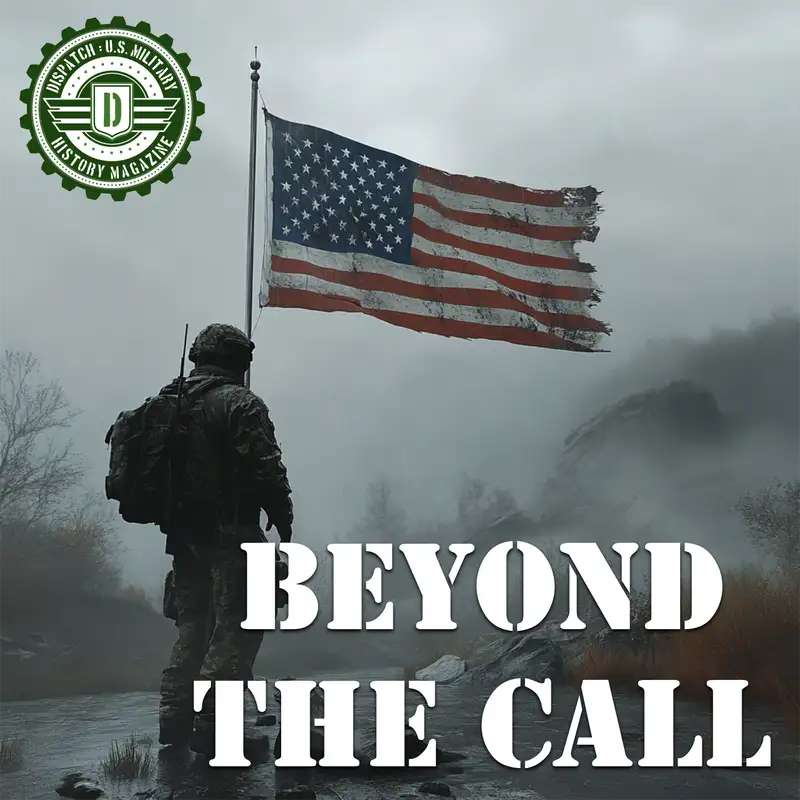
Beyond the Call: Sergeant John C. Squires at Spaccasassi Creek near Padiglione, Italy, 1944
Welcome to Beyond the Call, where history, leadership, and heroism come alive. Today’s story explores Private First Class John C. Squires at Spaccasassi Creek in nineteen forty four, a powerful account of courage and responsibility in combat. If you enjoy learning more about military history and extraordinary individuals, you can find more articles, podcasts, and resources at Trackpads dot com.
Night lay over the Italian countryside near the village of Padiglione, broken only by distant flashes of artillery and the faint shimmer of flares. Along a narrow road and a shallow creek called Spaccasassi, soldiers of Company A, thirtieth Infantry Regiment, moved forward as part of a larger push to crack German defenses. They walked past fields, ditches, and scattered farm buildings, feeling the weight of their gear and the tension of not knowing when the first shot would come. Among them moved Private First Class John C. Squires, a teenager from Louisville, Kentucky, serving as the platoon messenger. He was there to carry words, but he soon carried much more.
The quiet shattered when an antitank mine exploded under the leading platoon’s vehicle. The blast hurled metal, earth, and men into the air, blowing a hole in the road and in the unit’s carefully laid plan. Almost at once, German artillery and mortar fire crashed in, searching for the stalled column. Shells burst in the ditches and fields, flinging shrapnel through the darkness and splitting squads apart. In moments, what had been an ordered advance became confusion and fear. Men hugged the ground, and the attack threatened to die in the worst possible place.
Into that chaos, Squires moved toward danger instead of away from it. His task was to reach the forward platoon and bring back information, yet what he found there was more than a damaged vehicle. He saw wounded soldiers, scattered survivors, and a road turned into a funnel for enemy fire. The distance he had to cross was short, but under accurate shelling it felt very long. He kept going until he understood what had happened and what ground still could be used.
Squires did not simply return with news that the way ahead was blocked. As he made his way back through the same storm of shellbursts, he carried in his head a new route that threaded around the wreckage. He had studied the lay of the land and noted ditches, folds in the earth, and patches of cover that could shelter an advance. Reaching his leaders, he delivered more than a verbal report. He offered a workable path forward through an area that had just been turned into a killing zone. That choice to solve the problem, not just describe it, was his first step beyond the call.
But the mine and the barrage had left more damage than a broken plan. Stragglers lay in ditches or crouched behind low embankments, cut off from their sections and unsure where their squads had gone. Here again, Squires chose to act. He moved from man to man, calling out over the noise, waving them toward him, and turning fragments of units into a makeshift squad. It was dangerous work, done under fire and in the dark. Bit by bit, he rebuilt a forward element that could still fight.
Crossing Spaccasassi Creek under enemy fire was the next test. The Germans had turned the stream line and its banks into a defensive belt, with machine guns, machine pistols, and grenades waiting for any attempt to cross. With experienced noncommissioned officers already hit, the small group that reached the far bank found itself thin and exposed. Squires stepped into a role usually filled by older men. He placed eight soldiers in firing positions of his own choosing along the creek draw, moving up and down the line to adjust the angle of a rifle, shift a field of fire, or point out a likely enemy avenue of approach. Bullets snapped and grenades thudded into the ground, but he kept walking that small line.
As the night dragged on, the outpost paid a heavy price. The platoon tasked with holding the far bank was worn down by casualties until only fourteen men remained. They faced a determined enemy who understood how important this small lodgment was. Rather than wait passively for help, Squires slipped back through the danger zones not once but twice. He crossed barbed wire and an enemy minefield to reach the rear, gathered additional men who could still fight, and personally led them forward to reinforce the position. Beyond the Call is the Monday feature of Dispatch: U.S. Military History Magazine. In those hours, he was its living definition.
The Germans tried three times during the night to crush the American foothold along the creek. Each counterattack came with automatic fire and grenades, aimed at throwing the small group back into the water or wiping it out where it stood. Many soldiers in such a position might have stayed low in their foxholes and simply tried to survive. Squires refused to do that. He moved along the line, firing hundreds of rounds from his rifle and from a Browning automatic rifle, shifting his fire wherever German shapes appeared and encouraging others to keep shooting. His presence steadied the outpost.
One of the most striking parts of his story is how he turned the enemy’s weapons into tools of survival. During the fighting, he captured German Spandau machine guns and their ammunition, seizing the very guns that had been used to dominate the approaches. To make them useful, he questioned a captured German officer about how to operate them and quickly learned their controls. Then he showed his fellow soldiers how to fire and maintain the unfamiliar weapons. In a single night, he transformed an understrength platoon into a force with more firepower than before.
Later, he pushed still farther along the outpost’s southern end, where German soldiers continued to press the attack. There, at very close range, he fought a series of machine-gun duels with enemy troops. In that tight, deadly space, he forced twenty one Germans to surrender and captured thirteen additional machine guns. Each captured soldier and each seized weapon meant fewer rounds tearing into his own line. It meant more of his comrades living to see dawn. At this stage, his actions were shaping the entire local fight.
The official Medal of Honor citation speaks of “conspicuous gallantry and intrepidity at the risk of life above and beyond the call of duty.” In plain terms, that means a pattern of choices in which a person repeatedly places themselves in extreme danger to achieve vital results for others. For Squires, it began with walking toward the mine blast and ended with mastering enemy machine guns and using them to hold a fragile bridgehead. Other phrases in the citation, like “rounded up stragglers” and “organized a group of lost men into a squad,” describe leadership that does not depend on rank. They point to a young private first class who behaved like a seasoned leader when his unit most needed one.
On the map, his work at Spaccasassi Creek helped prevent a local American attack from failing at a mined road and narrow stream. On the ground, it meant wounded men were not left alone, the outpost did not fall, and the company kept a foothold that could be reinforced. In a campaign marked by bitter fighting over small pieces of terrain, holding this crossing mattered to the larger advance. His decisions under fire multiplied the strength of the men around him. Without that, the outcome on that sector of the line might have looked very different.
John C. Squires did not survive long after that terrible night. He was killed in action the next day, still only eighteen years old, having already done more for his comrades than most soldiers will ever be asked to do. His Medal of Honor was awarded after his death, honoring not just a single act but a sustained chain of courage, judgment, and leadership. He rests today in Zachary Taylor National Cemetery in his hometown of Louisville, where visitors can read his name and reflect on what it represents. His story endures as a reminder that greatness in war often comes from very young shoulders, and that one person’s refusal to yield can hold a fragile line between survival and defeat.