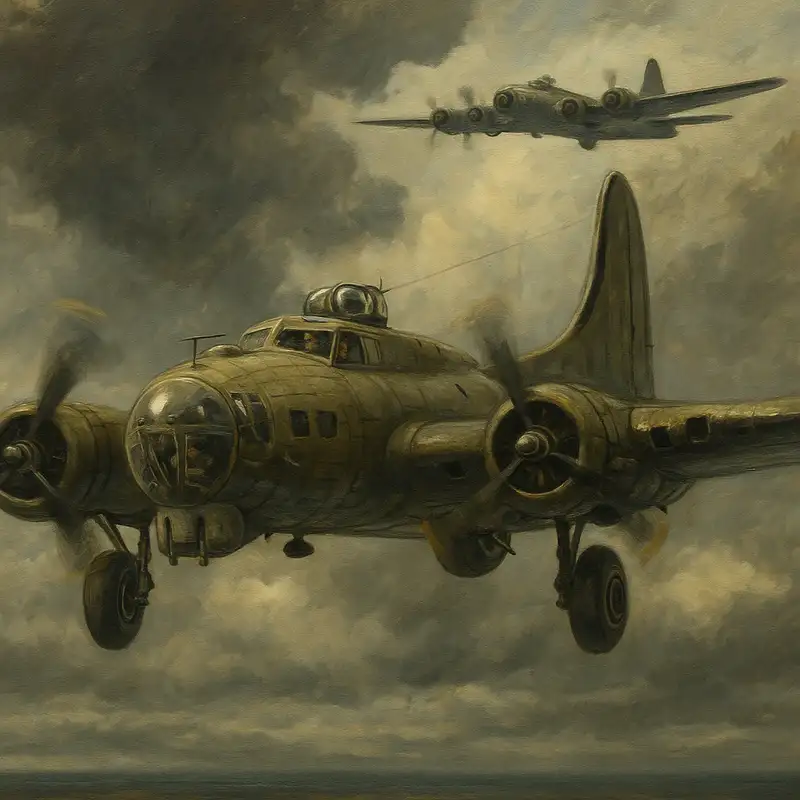
Beyond the Call: Second Lieutenant Walter Edward Truemper over Leipzig, 1944
Welcome to Beyond the Call, where history, leadership, and heroism come alive. Today’s story explores Second Lieutenant Walter Edward Truemper over Leipzig in 1944, a powerful account of courage and responsibility in combat. If you enjoy learning more about military history and extraordinary individuals, you can find more articles, podcasts, and resources at Trackpads dot com.
The moment that defined Walter Truemper’s life came not over the target, but on the long, wounded flight home. His B-17 bomber had been ripped apart by enemy fire, its cockpit shattered, its pilot gravely wounded and barely conscious. The copilot was dead, the radio operator hurt, and the aircraft staggered through the sky with damaged controls and failing instruments. Over England, circling near their home field, the crew received a stark order from the ground: the aircraft was too badly damaged to land safely, so those who could still move were to bail out. Beyond the Call is the Monday feature of Dispatch: U.S. Military History Magazine.
For Truemper, that decision point rested on years of quiet preparation far from any battlefield. He grew up in Aurora, Illinois, in a working family shaped by the hard years between the world wars. As a young man he studied business and worked as an accounting clerk, a job that rewarded patience, careful numbers, and steady habits. When the United States went to war, he left that predictable life and enlisted, trading ledgers for uniforms and drill fields. The Army first sent him to a field artillery unit in Texas, where he learned discipline, teamwork, and the physical demands of soldiering under a hot sun.
From there he was selected for flight training and moved into the demanding world of aircrew preparation. At preflight school, gunnery ranges, and navigation classes he learned to read maps, skies, and instruments under pressure. Night flights, bad weather, and strict instructors tested his ability to stay calm when things went wrong. Eventually he earned his commission as a second lieutenant in the Army Air Forces and became a navigator on a B-17 Flying Fortress. Posted to England with the Eighth Air Force, he joined a crew of the 351st Bombardment Group at their base in the British countryside, one more team in a vast air campaign.
By early 1944 the squadron lived in the harsh rhythm of daylight bombing. Morning briefings laid out targets deep inside Germany, and crews climbed into the thin, freezing air above the clouds. On February twentieth the mission board showed Leipzig, an important industrial center and a heavily defended objective. Truemper’s crew lifted off with the others, engines humming as the formation gathered and turned east. Over enemy territory the sky filled with black bursts of flak, and the thunder of exploding shells shook the bomber as it held position in the formation.
Then the fighters came in. German aircraft slashed through the formation, their cannon rounds tearing into aluminum and flesh. One of those attacks struck Truemper’s B-17 with devastating effect. The copilot was killed at his controls, the pilot was badly wounded and knocked unconscious, and the radio operator was hit. Control cables and instruments were damaged, and for a moment the bomber lurched as if it might tumble out of the sky. In that chaos, normal roles fell away, and survival depended on whoever could still move and think clearly.
Truemper and the flight engineer, Staff Sergeant Archibald Mathies, left their usual positions and fought to save the aircraft. They pulled the injured pilot from his seat, secured him as best they could, and struggled to bring the bomber under control. Neither man was trained to be the primary pilot, yet together they learned the feel of the damaged controls in seconds. They managed to steady the aircraft enough to stay with the formation for a time, then nursed it along as it dropped behind and began the lonely journey home. Behind them lay enemy territory; ahead lay the hope of reaching England before the aircraft failed completely.
The homeward flight felt endless. The crew checked on one another, tended to the wounded, and watched the engines with anxious eyes. Every new vibration carried the threat that something vital might give way. Still, the B-17 held together long enough to cross hostile territory and then open water. At last the English coastline appeared beneath the wings, a dark line of safety after hours of fear. Another aircraft flew close alongside, its crew able to see the torn metal and the improvised team at the controls, and radioed down what they saw.
On the ground, commanders weighed those reports and made a hard judgment. With the pilot helpless and the normal cockpit crew broken, landing such a badly damaged bomber seemed almost impossible. The order went out over the radio that the crew was to bail out over friendly soil. Men who could still move clipped on parachutes, said quick words to each other, and stepped into the roaring slipstream. Their descent would be dangerous, but rescue forces and hospitals were near, and the war would continue without them. Inside the aircraft, though, Truemper and Mathies stayed beside the wounded pilot.
When they were told again to leave, they replied that the pilot was still alive and that they would not desert him. At that instant their duty narrowed to a single point: three men in a shattered cockpit, one of them incapable of saving himself. Truemper and Mathies volunteered to attempt a landing, fully aware that their own chances of survival were slim. They brought the bomber around toward the airfield and tried to set it down, wrestling with controls that did not respond as they should. The aircraft veered and wobbled, forcing them to pull it back into the air and circle once more.
They tried again, and again the B-17 refused their efforts, damaged systems fighting every command they gave. A third attempt followed, each second heavy with the knowledge that they could have been floating under parachutes by then. On that final approach, the aircraft could no longer be coaxed into a safe landing. It crashed in an open field not far from the airfield, killing Truemper, Mathies, and the pilot they had refused to abandon. Their bodies were found still together, the last proof of a decision made with clear eyes and steady hearts.
The official Medal of Honor citation for Walter Truemper describes “conspicuous gallantry and intrepidity at the risk of life above and beyond the call of duty.” In plain terms, that means there is a difference between what duty demands and what a person chooses to do out of loyalty and conscience. Once the order to abandon the aircraft was given, duty would have allowed Truemper to jump and survive. Instead he and Mathies accepted almost certain death in a final effort to bring their pilot safely to earth. Their courage was measured not only in flying through flak, but in the refusal to be the men who walked away while a comrade died alone.
The air campaign of early 1944 depended on thousands of such choices, large and small. Tactically, their efforts turned a likely crash in enemy territory into a return over friendly soil, where most of the crew could survive and be rescued. Morally, their decision showed what trust within a crew could mean when everything was stripped down to life and death. For other airmen hearing the story, it became a quiet standard, a reminder that the bonds formed inside a cramped fuselage at high altitude could demand the highest possible price.
In June 1944 the United States awarded the Medal of Honor posthumously to both Walter Edward Truemper and Archibald Mathies. Truemper was brought home and buried in Illinois, near the town where he had grown up, and his name has been given to streets and memorials at bases where aircrews still train. In his hometown, monuments and plaques help tell his story to new generations who never knew the roar of four radial engines overhead. Together, he and Mathies are remembered not as figures in a textbook, but as two young men who chose to share a comrade’s fate rather than save themselves. Their story endures as a reminder that real courage is often quiet, and that the greatest acts of heroism can take place far from the front page, in the cramped cockpit of a doomed aircraft.