Beyond the Call: Major William Arthur Shomo over Luzon, 1945
Welcome to Beyond the Call, where history, leadership, and heroism come alive. Today’s story explores Major William Arthur Shomo over Luzon in nineteen forty five, a powerful account of courage and responsibility in combat. If you enjoy learning more about military history and extraordinary individuals, you can find more articles, podcasts, and resources at Trackpads dot com.
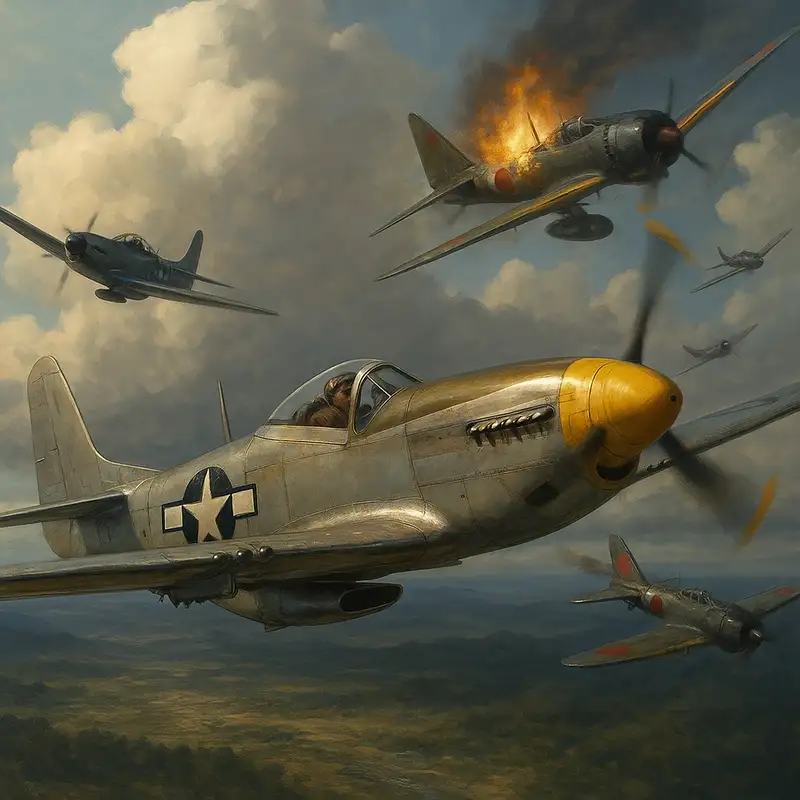
The morning sky over northern Luzon lies in soft layers of cloud and haze as Major William Arthur Shomo guides his reconnaissance Mustang along the coastline. His mission is simple on paper: an armed photographic sweep over the Japanese airfields at Aparri and Laoag, far ahead of friendly lines, with a single wingman on his flank. The two fighters carry cameras and guns, meant to spot and harass ground targets, not to challenge major enemy formations. The air seems strangely quiet. In that quiet, Shomo keeps scanning both earth and sky, looking for airstrips, barges, and the sudden glint of enemy aircraft.
When he slides past a bank of clouds, the quiet breaks. Ahead and above, a compact enemy formation cuts across his path, a twin engine bomber wrapped in a ring of fighters, moving at about two thousand five hundred feet higher and in the opposite direction. As he watches, the individual aircraft resolve into a count: one bomber and twelve escorts, thirteen machines in all, against his two. The odds are brutal. Beyond the Call is the Monday feature of Dispatch: U.S. Military History Magazine. In seconds, Shomo understands he can either pass beneath that formation and finish his photo run or turn into it and try to end a threat before it reaches the landing forces to the south.
The man in that cockpit did not arrive there by accident. William Arthur Shomo was born in nineteen eighteen in Jeannette, Pennsylvania, a small industrial town in the western part of the state. Family stories included the Johnstown Flood and the way earlier generations had faced disaster, reminders that catastrophe could come suddenly and that survival often depended on calm choices made under pressure. As a young adult he studied embalming in Cincinnati and Pittsburgh and became a mortician, tending to families in their worst moments. It was demanding, quiet work that required precision, steadiness, and a willingness to keep going when emotion filled the room. Those habits would travel with him into the war.
When the United States moved toward open conflict in nineteen forty one, Shomo left the funeral home for the Aviation Cadet Program of the Army Air Forces. There he learned navigation, gunnery, formation flying, and the discipline of operating complex machines in unforgiving conditions. Instructors saw a man who did not boast but who prepared carefully and flew exactly as briefed. He earned his commission and his wings, then joined the Eighty Second Tactical Reconnaissance Squadron in the southwest Pacific. Over New Guinea and the islands north of Australia, he flew long, lonely missions, often at low level, photographing enemy positions and strafing targets of opportunity. Quiet professionalism became his trademark.
By January eleven, nineteen forty five, that experience placed him in the lead cockpit of a two ship reconnaissance flight over Luzon. His orders focused on enemy airfields, not dogfights, and the war around him had entered a new phase as American troops pushed ashore at Lingayen Gulf. The Japanese air arm in the Philippines was under relentless pressure but still dangerous, and every surviving bomber and fighter represented a real threat. When Shomo saw the thirteen enemy aircraft sliding across his path, he felt the weight of that reality. He could report the sighting and complete the mission, or he could strike first and accept the risk that came with it.
He chose to strike. Shomo ordered his wingman to follow and pushed the throttle forward, hauling his Mustang into a climbing turn toward the rear of the enemy formation. From below and behind, the two American fighters had a moment of advantage, small shapes rising out of the haze where the defenders might not think to look. Shomo aimed at the trailing element of fighters and closed until the enemy filled his gunsight. His first burst of fifty caliber fire ripped into the lead plane of that element, and it shattered into pieces, falling away in flames. One fighter was gone, and the neat ring around the bomber already showed its first gap.
Without pausing, he rolled his aircraft and curved across the side of the formation, shifting his aim to another fighter trying to swing into position. Again he pressed the trigger and walked his fire through the enemy plane until it, too, fell away in a trail of smoke and burning metal. The remaining escorts began to react now, breaking into defensive turns and trying to form for a counterattack, but the sky around the bomber was no longer orderly. Shomo darted through these shifting arcs, choosing angles that let him attack from above or behind rather than accepting level head on passes. It was aggressive flying, but it was not reckless.
With the escorts unraveling, he turned his focus to the bomber at the center of the group. Dropping below it, he pulled his Mustang up sharply into the bomber’s belly, firing a long burst that tore into engines, wing roots, and fuel. Flames blossomed along the underside as shattered metal flew back past his canopy. The twin engine aircraft rolled away, mortally wounded, and began a long, burning fall toward the ground. Almost at once, a fighter lunged at him in a head on attack. Shomo held his course a heartbeat longer, fired first, and saw the enemy aircraft disintegrate before he flashed through the space it had occupied.
All around him, the fight dissolved from a tight formation into scattered duels. Shomo hunted down another fighter, closing from behind and firing until it tumbled away, then dove after one more that tried to escape at low altitude. He chased it down to about three hundred feet, closed the distance, and brought it down with a final burst that sent it crashing into the terrain below. His wingman, following his lead, destroyed three additional fighters during the melee. In only a few minutes, ten of the original thirteen enemy aircraft had been destroyed, seven by Shomo’s gunfire and three by his partner. Two American fighters now flew where a powerful enemy formation had been.
The official Medal of Honor citation would later describe this action with careful, formal words about “conspicuous gallantry” and “intrepidity” above and beyond the call of duty. Behind those phrases stand very concrete realities. A flight of two aircraft attacked thirteen and destroyed ten. A pilot elected to climb into a position of disadvantage because waiting meant letting a bomber reach vulnerable ships and airfields. The language about risking his life is not abstract. Each climb into the enemy’s guns, each pass through converging fire, presented a real chance that his Mustang would not come back.
On a tactical level, the results were clear. A bomber and most of its escorts that might have struck the Luzon landings were gone before they could threaten the ships and airfields supporting the advance. Shomo and his wingman returned with their aircraft intact and ready for more reconnaissance missions, so the squadron did not pay for that success with permanent losses of its own. The skies over the invasion forces were a little safer that day because one small flight refused to yield the initiative. These are the quiet math problems of war. Someone decides whether potential losses are worth the risk of action.
On a human level, Shomo’s leadership mattered as much as his shooting. Years of working as a mortician had taught him to stay calm around death and to keep moving through tasks when emotions ran high, and those habits showed in the cockpit. He did not fling his two ship flight into a wild charge. Instead, he used surprise, altitude, and position to break the enemy formation and present his wingman with manageable targets. He took the greater share of the risk onto himself, but he also gave the younger pilot a clear pattern to follow and space to fight. That is what responsible courage looks like.
The story did not end when the guns fell silent. In April nineteen forty five, at a forward airfield in the Philippines, Major Shomo received the Medal of Honor in front of his peers, recognition not only for that single mission but for more than two hundred combat sorties across the southwest Pacific. After the war he stayed in uniform, transitioning into the United States Air Force and serving in fighter interceptor and air defense units across the United States, Labrador, and Greenland. He eventually retired as a lieutenant colonel in nineteen sixty eight, having spent decades preparing younger pilots to defend new skies. His combat Mustang was long gone, but the standards he set in it remained.
William Arthur Shomo died in nineteen ninety and was laid to rest in Pennsylvania, not far from where his life began. His name appears on the rolls of Medal of Honor recipients and in histories of the war in the Pacific, but it also lives in the quieter spaces where pilots talk about what it means to act when no one would fault you for holding back. His mission over Luzon is remembered as an “ace in a day” story, yet the heart of it is something deeper. It is the story of a measured man who chose a harder path because he believed it would save others, and who turned impossible odds into a brief, blazing victory. Remembering him means remembering that such choices are made by real people, one cockpit, one decision, and one pull of the trigger at a time.